NCERT solutions for class 11 physics chapter 4 motion in a plane
Q-1: State whether the following physical quantities are scalar or vector.
(i) Mass
(ii) Volume
(iii) Speed
(iv) Acceleration
(v) Density
(vi) Number of moles
(vii) Velocity
(viii) Angular frequency
(ix) Displacement
(x) Angular velocity
Ans:
Scalar: Density, mass, speed, volume, angular frequency, number of moles.
Vector: Velocity, acceleration, angular velocity, displacement.
A scalar quantity depends only on the magnitude and it is independent of the direction. Density, mass, speed, volume, angular frequency and number of moles are scalar quantities.
A vector quantity depends on the magnitude as well as the direction. Velocity, acceleration, angular velocity, displacement comes under this.
Q-2: From the following pick any two scalar quantities:
Force, angular momentum, work, current, linear momentum, electric field, average velocity, magnetic momentum, relative velocity.
Ans:
The dot product of force and displacement is the work done. Work is a scalar quantity since dot product of two quantity is always scalar.
Current is a scalar quantity as it is described only by its magnitude and it is independent of direction.
Q-3: From the following identify the vector quantities:
Pressure, temperature, energy, time, gravitational potential, power, total path length, charge, coefficient of friction, impulse.
Ans:
Impulse is the product of force and time. Since force is a vector quantity, its product with time which is a scalar quantity gives a vector quantity.
Q-4: State with reasons, whether the following algebraic operations with scalar and vector physical quantities are meaningful :
(a) Addition of any two scalars
(b) Adding a scalar to a vector which has the same dimensions
(c) Multiplying a vector by any scalar
(d) Multiplying any two scalars
(e) Adding any two vectors
(f) Addition of a vector component to the same vector.
Ans:
(a) Meaningful:
The addition of two scalar quantities is meaningful only if they both represent the same physical quantity.
(b) Not Meaningful:
The addition of a vector quantity with a scalar quantity is not meaningful
(c) Meaningful:
A scalar can be multiplied with a vector. For example, force is multiplied with time to give impulse.
(d) Meaningful:
A scalar, irrespective of the physical quantity it represents, can be multiplied by another scalar having the same or different dimensions.
(e) Meaningful:
The addition of two vector quantities is meaningful only if they both represent the same physical quantity.
(f) Meaningful:
A component of a vector can be added to the same vector as they both have the same dimensions.
Q-5: Read each statement below carefully and state with reasons, if it is true or false:
(a) The magnitude of a vector is always a scalar
(b) Each component of a vector is always a scalar
(c) The total path length is always equal to the magnitude of the displacement vector of a particle
(d) The average speed of a particle (defined as total path length divided by the time taken to cover the path) is either greater or equal to the magnitude of the average velocity of the particle over the same interval of time
(e) Three vectors not lying in a plane can never add up to give a null vector.
Ans:
(a) True:
The magnitude of a vector is a number. So, it is a scalar.
(b) False:
Each component of a vector is also a vector.
(c) False:
The total path length is a scalar quantity, whereas displacement is a vector quantity. Hence, the total path length is always greater than the magnitude of displacement. It becomes equal to the magnitude of displacement only when a particle is moving in a straight line.
(d) True:
It is because of the fact that the total path length is always greater than or equal to the magnitude of displacement of a particle.
(e) True:
Three vectors, which do not lie in a plane, cannot be represented by the sides of a triangle taken in the same order.
Q-6: Establish the following vector inequalities geometrically or otherwise:
(a)
(b)
(c)
(d)
When does the equality sign above apply?
Ans:
(a) Let two vectors

Here,
Each side in a triangle is smaller than the sum of the other two sides.
Therefore, in
QS < (QR + RS)
If the two vectors
Combine equation (iv) and (v),
(b) Let two vectors

Here,
Each side in a triangle is smaller than the sum of the other two sides.
Therefore, in
QS + RS > QR
QS + QR > RS
If the two vectors
Combine equation (iv) and (v):
(c) Let two vectors

Here,
Each side in a triangle is smaller than the sum of the other two sides.
Therefore, in
PR < PS + SR
If the two vectors act along a straight line in the opposite direction, then:
Combine (iii) and (iv),
(d) Let two vectors
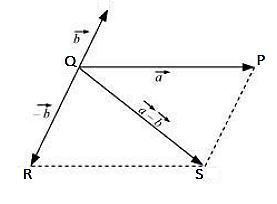
Here,
PR + SR > PS —– (i)
PR > PS – SR —– (ii)
The quantity on the left hand side is always positive and that on the right hand side can be positive or negative.
We take modulus on both the sides to make both quantities positive:
If the two vectors act along a straight line in the opposite direction, then:
Combine (iv) and (v):
Q-7: Given that l + m + n + o = 0, which of the given statements are true:
(a) l, m, n and o each must be a null vector.
(b) The magnitude of (l + n) equals the magnitude of (m+ o).
(c) The magnitude of l can never be greater than the sum of the magnitudes of m, n and o.
(d) m + n must lie in the plane of l and o if l and o are not collinear, and in the line of l and o, if they are collinear?
Ans:
(a) False
In order to make l + m + n + o = 0, it is not necessary to have all the four given vectors to be null vectors. There are other combinations which can give the sum zero.
(b) True
l + m + n + o = 0
l + n = – (m + o)
Taking mode on both the sides,
Therefore, the magnitude of (l + n) is the same as the magnitude of (m + o).
(c) True
l + m + n + o = 0
l = (m + n + o)
Taking mode on both the sides,
Equation (i) shows the magnitude of l is equal to or less than the sum of the magnitudes of m, n and o.
(d) True
For,
l + m + n + o = 0
The resultant sum of the three vectors l, (m + n), and o can be zero only if (m + n) lie in a plane containing l and o, assuming that these three vectors are represented by the three sides of a triangle.
If l and o are collinear, then it implies that the vector (m + n) is in the line of l and o. This implication holds only then the vector sum of all the vectors will be zero.
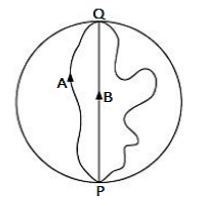
Q-8: Three girls skating on a circular ice ground of radius 200 m start from a point P on the edge of the ground and reach a point Q diametrically opposite to P following
different paths as shown in Fig. 4.20. What is the magnitude of the displacement vector for each? For which girl is this equal to the actual length of path skate?
Ans:
The distance between the initial and the final position of the particle is called the displacement. All the three girls reach from point P to Q. The diameter of the ground is the magnitude of displacement.
Radius = 200 m
Diameter = 200 x 2 = 400 m
Hence, the magnitude of displacement is 400 m for each girl. This magnitude is equal to the path skated by girl B.
Q-9: A cyclist starts from the centre O of a circular park of radius 1 km, reaches the edge P of the park, then cycles along the circumference, and returns to the centre along QO as shown in Fig. 4.21. If the round trip takes 10 min, what is the
(i) Net displacement
(ii) Average velocity and
(iii) The average speed of the cyclist.
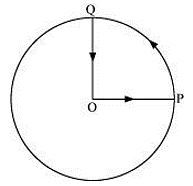
Ans:
(i) The distance between the initial and final position of the body is called displacement. The cyclist comes back to the place where he had started in 20 minutes. So, the displacement is zero.
(ii) Average Velocity =
As the displacement is zero, the average velocity is zero.
(iii) Average speed =
Total path length = OP + PQ + QO
= 1 +
= 2 +
= 3.570 km
Time = 20 minutes =
Average Speed =
Q-10: On an open ground, a motorist follows a track that turns to his left by an angle of 600 after every 500 m. Starting from a given turn, specify the displacement of the motorist at the third, sixth and eighth turn. Compare the magnitude of the displacement with the total path length covered by the motorist in each case
Ans.
The path followed by the motorist is a regular hexagon with side 500 m as given in the figure.

Let the motorist start from point P.
The motorist takes the third turn at S.
Therefore,
Magnitude of the displacement = PS = PV + VS
= 500 + 500 = 1000 m
Total path length = PQ + QR + RS
= 500 + 500 + 500 = 1500 m
The motorist takes the 6th turn at point P, which is the starting point.
Therefore,
Magnitude of displacement = 0
Total path length = PQ + QR + RS + ST + TU + UP
= 500 + 500 + 500 + 500 + 500 + 500 = 3000 m
The motorist takes the eight turn at point R.
Magnitude of displacement = PR
=
=
=
= 866.03 m
= 30°
Therefore, the magnitude of displacement is 866.03 m at an angle of 30° with PR.
Total path length = Circumference of the hexagon + PQ + QR
= 6 × 500 + 500 + 500 = 4000 m
The magnitude of displacement and the total path length corresponding to the required turns is shown in the following table:
| Turn | The magnitude of displacement (m) | Total path length (m) |
| 3rd | 1000 | 1500 |
| 6th | 0 | 3000 |
| 8th | 866.03; | 4000 |
Q-11: A passenger arriving in a new town wants to go from the station to a hotel located 10 km away on a straight road from the station. A dishonest cabman takes him along a circuitous path 23 km long and reaches the hotel in 28 min.
(a) What is the average speed of the taxi?
(b) What is the magnitude of average velocity? Are the two equal?
Ans.
(a) Total distance travelled = 23 km
Total time taken = 28 min =
Therefore,
Average speed =
=
(b) Distance between the hotel and the station = 10 km = Displacement of the car
Therefore,
Average velocity =
The two physical quantities are not equal.
Q-12: Rain is falling vertically with a speed of 30
Ans:
The described situation is shown in the given figure

Here,
In order to protect herself from the rain, the woman must hold her umbrella in the direction of the relative velocity (v) of the rain with respect to the woman.
= 30 + (-10) = 20 m/s
=
=
Hence, the woman must hold the umbrella toward the south, at an angle of nearly 18° with the vertical.
Q-13: A man can swim with a speed of 4 km/h in still water. How long does he take to cross a river 1 km wide if the river flows steadily at 3 km/h and he makes his strokes normal to the river current? How far down the river does he go when he reaches the other bank?
Ans:
Speed of the man
Width of the river = 1 km
Time taken to cross the river =
=
=
Speed of the river,
Distance covered with flow of the river =
=
=
=
Q-14: In a harbour, the wind is blowing at the speed of 72 km/h and the flag on the mast of a boat anchored in the harbour flutters along the N-E direction. If the boat starts moving at a speed of 51 km/h to the north, what is the direction of the flag on the mast of the boat?
Ans:
Velocity of the boat =
Velocity of the wind =
The flag is fluttering in the northeast direction. It shows that the wind is blowing toward the north-east direction. When the ship begins sailing toward the north, the flag will move along the direction of the relative velocity (
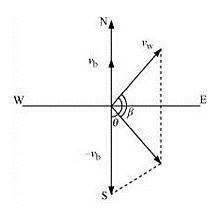
The angle between
=
=
=
=
=
=
Angle with respect to the east direction = 45.11° – 45° = 0.11°
Hence, the flag will flutter almost due east.
Q-15: The ceiling of a long hall is 25 m high. What is the maximum horizontal distance that a ball is thrown with a speed of 40
Ans:
Speed of the ball, u = 40 ms-1
Maximum height, h = 25 m
In projectile motion, the maximum height achieved by a body projected at an angle
Horizontal range, R:
=
=
=
=
Q-16: A cricketer can throw a ball to a maximum horizontal distance of 100 m. How much high above the ground can the cricketer throw the same ball?
Ans:
Maximum horizontal distance, R = 100 m
The cricketer will only be able to throw the ball to the maximum horizontal distance when the angle of projection is 45° i.e.,
The horizontal range for a projection velocity v, is given as:
R =
The ball will achieve the max height when it is thrown vertically upward. For such motion, the final velocity v is 0 at the max height H.
Acceleration, a = – g
Using the 3rd equation of motion:
=
Q-17: A stone tied to the end of a string 80 cm long is whirled in a horizontal circle with a constant speed. If the stone makes 14 revolutions in 25 s, what is the direction and magnitude of the acceleration of the stone?
Ans:
Length of the string, l = 80 cm = 0.8 m
No. of revolutions = 14
Time taken = 25 s
Frequency, v =
Angular frequency
=
=
=
Centripetal acceleration:
The direction of centripetal acceleration is always directed along the string, toward the centre, at all points.
Q-18: An aircraft executes a horizontal loop of radius 1 km with a steady speed of 900 km h-1.Compare its centripetal acceleration with the acceleration due to gravity.
Ans:
Radius of the loop, r = 1 km = 1000 m
Speed, v = 900 km h-1 =
Centripetal acceleration:
=
Acceleration due to gravity, g = 9.8 ms-2
Q-19: Read each statement below carefully and state, with reasons, if it is true or false:
(a) The net acceleration of a particle in a circular motion is always along the radius of the circle towards the centre.
(b) The velocity vector of a particle at a point is always along the tangent to the path of the particle at that point.
(c) The acceleration vector of a particle in uniform circular motion averaged over one cycle is a null vector.
Ans:
(a) False
The net acceleration of a particle in a circular motion is always directed along the radius of the circle toward the centre only in the case of uniform circular motion.
(b) True
At a point on a circular path, a particle appears to move tangentially to the circular path.
(c) True
In uniform circular motion (UCM), the direction of the acceleration vector points toward the centre of the circle. However, it constantly changes with time. The average of these vectors over one cycle is a null vector.
Q-20: The position of a particle is given by
Where t is in seconds and the coefficients have the proper units for r to be in meters.
(a) Find the ‘v’ and ‘a’ of the particle?
(b) What is the magnitude and direction of the velocity of the particle at t = 2.0 s?
Ans:
(a) The position of the particle is given by:
Velocity
Acceleration
8.54 m/s,
(b) we have velocity vector,
At t = 2.0 s:
The magnitude of velocity is given by:
Direction,
The negative sign indicates that the direction of velocity is below the x – axis.
Q-21: A particle starts from the origin at t = 0 s with the velocity of
(a) At what time is the x-coordinate of the particle 16 m? What is the y-coordinate of the particle at that time?
(b) What is the speed of the particle at the time?
Ans:
(a) Velocity of the particle =
Acceleration of the particle =
But,
Integrating both the sides:
Where,
But,
=
Integrating the equations with the conditions:
At t = 0; r = 0 and at t = t; r = r.
Since the motion of the particle is confined to the x-y plane, on equating the coefficients of
t =
y =
When x = 16 m:
Therefore, y = 10 × 2 +
(b) Velocity of the particle:
At t = 2 s:
Therefore, Speed of the particle:
Q-22:
Ans:
Consider a vector
Comparing the components on both the sides, we get:
Therefore, the magnitude of the vector
Let
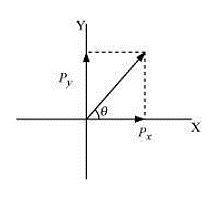
Therefore, the vector
Let
Therefore, the magnitude of the vector
Let
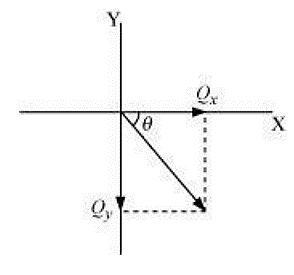
Therefore, the vector
It is given that,
Comparing the components on both the sides, we get:
Let
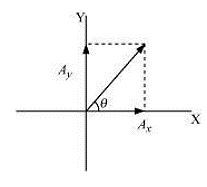
Angle between the vectors
Components of vector
=
=
=
=
=
=
Let
Component of vector
=
=
=
=
=
=
=
=
Q-23: Which of the given relations are true for any arbitrary motion in space?
(a)
(b)
(c)
(d)
(e)
Ans:
(a) False
It is given that the motion of the particle is arbitrary. Therefore, the average velocity of the particle cannot be given by this equation.
(b) True
The arbitrary motion of the particle can be represented by this equation.
(c) False
The motion of the particle is arbitrary. The acceleration of the particle may also be non-uniform. Hence, this equation cannot represent the motion of the particle in space.
(d) False
The motion of the particle is arbitrary; acceleration of the particle may also be non-uniform. Hence, this equation cannot represent the motion of a particle in space.
(e) True
The arbitrary motion of the particle can be represented by this equation.
Q-24: Read each statement below carefully and state, with reasons and examples, if it is true or false :
A scalar quantity is one that
(a) is conserved in a process
(b) can never take negative values
(c) must be dimensionless
(d) does not vary from one point to another in space
(e) has the same value for observers with different orientations of axes
Ans:
(a) False
Despite being a scalar quantity, energy is not conserved in inelastic collisions.
b) False
Despite being a scalar quantity, the temperature can take negative values.
c) False
The total path length is a scalar quantity. Yet it has the dimension of length.
d) False
A scalar quantity such as gravitational potential can vary from one point to another in space.
e) True
The value of a scalar does not vary for observers with different orientations of axes.
Q-25: A bird is flying 350 m high. A person is standing on the ground notices that the bird subtends
Ans:
Figure shows the position of the kite with respect to person,
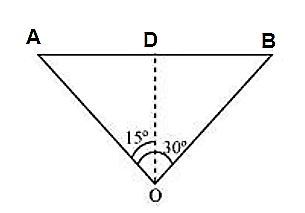
Height of the kite = OD = 350 m
Angle subtended by bird =
Time = 12 s
In
Thus,
Here,
Therefore, AD = BD
AB = AD + BD
= 2AD = (2×350) tan 15° = 187.56 m
Now, the speed of the bird = 187.56/12 = 15.63 s
Q-26: Does a vector have a location in space? Will it fluctuate with time? Can two equivalent vectors x and y at various locations in space fundamentally have indistinguishable physical effects? Give cases in support of your answer.
Ans:
No, Yes and No.
A vector in space has no distinct location. The reason behind this is that a vector stays invariant when it displaces in a way that its direction and magnitude does not change. Although, a position vector has a distinct location in space.
A vector change with time. For instance, the velocity vector of a ball moving with a specific speed fluctuates with time.
Two equivalent vectors situated at different locations in space do not generate the same physical effect. For instance, two equivalent forces acting at different points on a body tend to rotate the body, but the combination will not generate the equivalent turning effect.
Q-27: As a vector is having both direction and magnitude, then is it necessary that if anything is having direction and magnitude it is termed as a vector? The rotation of an object is defined by the angle of rotation about the axis and direction of rotation of the axis. Will it be a rotation of a vector?
Ans:
No and no
A physical quantity which is having both direction and magnitude is not necessarily a vector. For instance, in spite of having direction and magnitude, the current is a scalar quantity. The basic necessity for a physical quantity to fall in a vector category is that it ought to follow the “law of vector addition.”
As the rotation of a body about an axis does not follow the basic necessity to be a vector i.e, it does not follow the “law of vector addition”, so it is not a vector quantity. Although in some cases rotation of a body about an axis by a small angle follows the law of vector addition so it is termed as a vector.
Q-28: Can we associate a vector with
(i) a sphere?
(ii) the length of a wire bent into a loop
(iii) a plane area
Clarify for the same.
Ans.
No, No, Yes
(i) We can’t associate the volume of a sphere with a vector, but the area of a sphere can be associated with an area vector.
(ii) We can’t associate the length of a wire bent into a loop with a vector.
(iii) We can associate a plane area with a vector.
Q-29: A ball is thrown at
Ans:
No.
Angle of projection
Range r = 50 m
g = 9.81 m/s2
Horizontal range with velocity (v) is given by:
In projectile motion the maximum range is obtained when
So,
Now, comparing (a) and (b):
Thus,
So, the target to hit 70 m away cannot be achieved.
Q-30: A helicopter flying horizontally at an altitude of 2 km with a speed of 420 km/h passes above the machine gun. Find the angle at which the gun should be fired with the shell in order to hit the helicopter. Muzzle speed is 300 ms-1. Find out the minimum altitude at which the pilot can fly the helicopter in order to avoid being hit? Assume, g = 10 m/s2.
Ans:
Speed of the Helicopter = 420 km/h = 166.67 m/s
Height at which the helicopter is flying = 2 km = 2000 m
Let the machine gun makes an angle
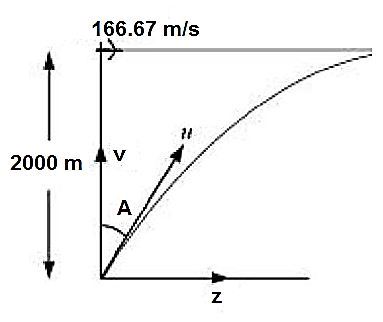
Time taken by the shell to hit the helicopter = t
Horizontal distance travelled by the shell = zt
Distance travelled by the helicopter = vt
Muzzle velocity of the gun = 420 m/s
As the shell hits the helicopter. Thus, both the distance should be equal.
zt = vt
Now, to avoid being hit by the shell, the pilot should fly the helicopter at altitude (H) higher than the maximum height that can be achieved by the shell.
= 4500 × 0.84922
= 3822.56 = approx 3.8 km
Q-31: A biker is riding his bike at the speed of 54 km/h. As the rider approaches the circular turn on the road having radius 70 m, he reduces the speed of bike at a constant rate of 0.70 m/s2, by applying brakes. Find out the direction and magnitude of the net acceleration of the biker on this turn.
Ans.
Radius of turn = 70 m
Speed of bike = 54 km/h = 15 m/s
Now, centripetal acceleration:
The problem is shown in the fig.
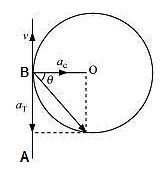
Assuming that a biker starts its journey from point A and moves towards point B. Now, at point B he decelerates the speed of bike by 0.70 m/s2 applying breaks.
So, this acceleration (aT)is in the opposite direction to the motion of the biker and along the tangent at B.
Now,
Thus,
Q-32: Prove that for a projectile motion the angle between x- axis and velocity as a function of time and is given by:
Also prove that the angl:e of projection when a projectile is launched from origin is given by:
Ans:
Assuming the vx = initial velocity of component in x- direction and vy = initial velocity of component in y- direction
Assuming the ux = velocity of component at point O in x- direction and uy = velocity of component at point O in y- direction
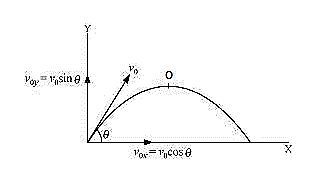
The projectile reaches point O in time, t.
Applying the 1st law of motion along vertical and horizontal direction,
u = v + gt, here v = u
Therefore,
Now, maximum vertical height:
Horizontal Range:
Now, solving (a) and (b), we get:
EmoticonEmoticon